
Projected vs Actual Jeffco Release
A projected release date is not the same as an actual release. For the Jefferson County Detention Facility, the best sourced information is operational: inmates may be released any time, 24 hours a day, 7 days a week, and processing usually takes two to six hours after the jail receives a release order. The handbook says release times vary, cannot be predicted, and include a final warrant check.
For CDOC, the public offender search is the state prison and parole locator. It may show status, facility or supervision location, DOC number, and release-related dates on an individual record. The research cautions that exact field labels should be confirmed from a live record before copy promises a specific label. For BOP, a past release date with no facility location means the federal release occurred on that date, according to BOP's records guidance.
Pretrial status is the most common source of confusion. A person held before case disposition often has no fixed release date because the next step depends on bond, a court order, warrant status, or a transfer. A sentenced county-jail inmate may have a more concrete local release path, but the public lookup still does not publish a future release calendar.
How to Find a Jeffco Release Date
Use the custody type first. A Jefferson County jail detainee, a CDOC inmate, and a federal inmate at FCI Englewood have different date sources.
- Search the Jeffco inmate lookup to see whether the person is still in current county custody.
- For a county jail release date, call jail information at (303) 271-5444 or request the release record from sheriff Records.
- Check Jefferson Combined Court records for the bond, sentence, dismissal, warrant, or transfer order behind the release.
- For a state prisoner, search the CDOC offender search by DOC number when available, then by name and date-of-birth guidance.
- For release alerts, use VINELink Release Check after confirming the person and agency match.
- For FCI Englewood, use the BOP Inmate Locator, not Jefferson County jail records.
Jefferson County Jail Release Timing
County jail release timing is not a public math formula. It can depend on whether the court order has reached the jail, whether bond paperwork is complete, whether another warrant exists, whether a hold or transfer applies, and whether release processing has finished. A person can have a court event that should lead to release while still waiting through jail processing.
| County jail factor | How it can affect release |
|---|---|
| Release order received | The two-to-six-hour processing estimate starts after the jail receives the order. |
| Final warrant check | A new or unresolved warrant can stop or delay physical release. |
| Bond paperwork | Payment, surety, PR bond, or co-signer details may need processing. |
| Transfer or hold | Another agency may become the next custody source. |
| Property and issued items | Issued items must be returned, and property/funds are handled under jail rules. |
The right confirmation source depends on the reason for release. Bond timing starts with the bond event and jail processing. Sentence completion may require court and jail records. A transfer may point to CDOC, BOP, ICE, or another agency. A dismissed or resolved case may be clearest in the court docket first, then the jail release record.
Colorado Six-Hour Bond Rule
Colorado bond law gives some release timing more structure. C.R.S. 16-4-102 requires release within six hours after a qualifying personal recognizance or cash-bond event unless extraordinary circumstances exist. Jefferson County materials also state that bond and booking fees are not required as a condition of release. HB25-1015 clarifies when the six-hour period starts for online or electronic bond payments.
The rule does not mean the person walks out the moment payment posts. It means the delay is bounded for qualifying events unless an exception applies. The sheriff handbook notes that if release is delayed beyond six hours, the surety and defendant have a right to know the reason, and a limited electronic-monitoring delay may apply in certain cases.
Electronic payment timing deserves care because HB25-1015 clarifies when the six-hour period starts for online or electronic bond payments. For a practical Jefferson County release-date question, keep the payment confirmation, bond type, court case number, and jail booking information together before calling the jail.
CDOC Release Date Search
The CDOC offender search uses a DOC number as the primary identifier. Search tips say the DOC number is numeric and up to six characters. Name searches return names beginning with the letters typed, date of birth should be entered as mm/dd/yyyy, and a checkbox can search six months before and after the date entered. The tips also caution not to hyphenate between two last names.
| CDOC search field | Use |
|---|---|
| DOC number | Best identifier when known. |
| Last name / first name | Returns names beginning with typed letters. |
| Gender | Helps narrow common names. |
| Date of birth | Use mm/dd/yyyy and optional range checkbox where offered. |
| Status and date fields | Read release, parole, discharge, or supervision information shown on the individual record. |
CDOC's disclaimer says database information may sometimes be inaccurate and directs users to contact CDOC to confirm all information. That disclaimer should be treated seriously when a projected date controls pickup, court, or family planning.
The CDOC parole board calendar adds a second state-level clue. It can show hearing schedules and future months once scheduling has been set, but the calendar warns that hearings are subject to change. A hearing date can explain why a release decision is pending, yet it does not prove that the person has already left custody.
Colorado Earned Time Rules
Colorado does not have one simple public rule that every inmate serves exactly the same percentage. C.R.S. 17-22.5-405 covers earned time, earned release time, and achievement earned time. The statute includes earned release time scheduling for certain lower-level felonies and drug felonies before mandatory release when criteria are met. Other provisions in Title 17 address parole eligibility and discharge.
Offense date, offense class, sentence, disciplinary history, parole-board authority, required plans, and statutory exceptions can all matter. Some categories require a larger served portion before eligibility. The safest public answer is that CDOC time computation and the sentencing judgment control the actual date.
For Jefferson County users, that means court records and CDOC records work together. The Jefferson County judgment explains the sentence. CDOC calculates state custody time after intake. The public search can help locate the person, but a disputed date should be confirmed with the department or counsel.
Do not carry county jail timing into a CDOC sentence. A Jeffco jail release estimate is measured from a local release order. A CDOC release date is calculated under state corrections law after prison intake.
Why Release Dates Change
| Reason | Effect on date |
|---|---|
| Good-time or earned-time changes | Can move a CDOC date forward or backward depending on eligibility and conduct. |
| Parole board action | A hearing date or grant may not equal immediate release. |
| Detainer or hold | May shift release into a transfer or continued custody question. |
| Court order | Can create, cancel, or alter jail release authority. |
| BOP recalculation | Federal projected dates may change due to sentence review or credits. |
CDOC Parole Calendar Source
The CDOC parole board calendar is relevant when a person is nearing a parole hearing or release review.
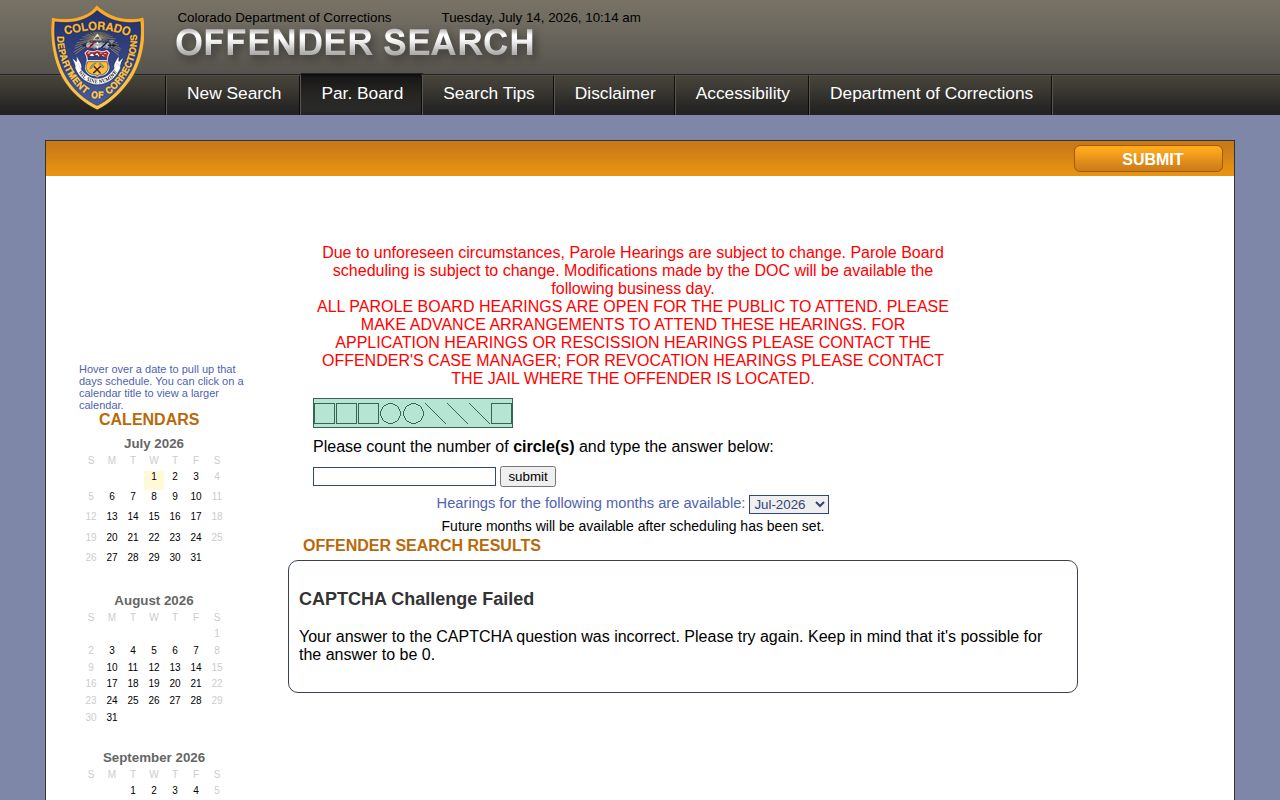
A calendar entry is a scheduling source. Completed release still needs the offender record, VINE, or agency confirmation.
Public Record Search
Sponsored Results